

Every winter, the plum tree outside Heinrich Wang's studio is the first to know spring is coming.
Pure white blossoms open quietly on the still-sleeping earth. No announcement. No noise. Just presence.
And yet — you cannot ignore them.
White does not demand attention. It simply holds the space, until everything else arranges itself around it.
Solitary, but never self-contained. Its existence gives the surroundings their shape.
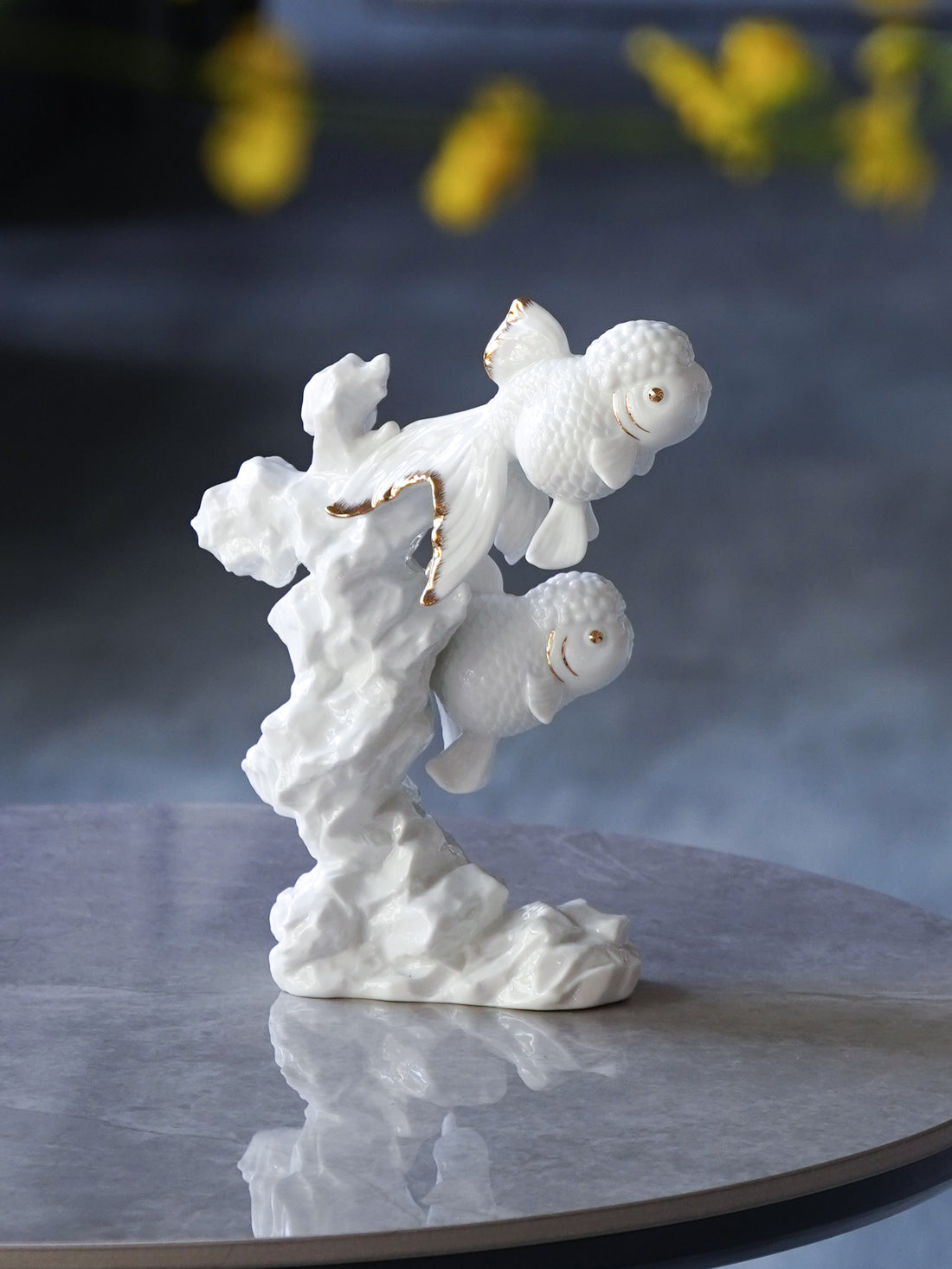
Heinrich Wang speaks spring through white porcelain — in the season most full of color.
White is not absence. It is the capacity to receive everything.

In 2003, Heinrich Wang stepped away from glass art and into white porcelain. By then, he had already reached the summit of his previous craft — works collected by the Palace Museum, the Corning Museum of Glass, and other insitute. He could have stayed.
He chose to leave.
Because he saw something that troubled him: Chinese porcelain, a vessel for eight thousand years of civilization, was losing ground — displaced by European and Japanese brands. And more troubling still — porcelain itself had stopped evolving. Round bodies. Cylindrical forms. Gentle, obedient, unchanged for a thousand years.
He designed a different kind of white porcelain and approached over eighty manufacturers. Not one would take the commission. So he began making it himself.
Only then did he discover how much harder porcelain was than glass. The shrinkage, cracking, and softening of clay at high temperatures — these had been the fundamental, unsolved constraints of porcelain-making for eighteen hundred years. In his book The Will of the Teapot, he wrote: "I must acknowledge that the ambition to change what eighteen hundred years of porcelain-making left unchanged — that is an act of audacity."
Audacity. But he did not stop.

Why White
White porcelain carries no colored glaze. Fired from kaolin, quartz, and feldspar, it keeps only the purest white and light. When color is removed, the eye returns to what is most essential — line, proportion, silhouette. Colored porcelain tells its story through pigment; white porcelain tells it through structure and shadow alone. Its beauty lives in the way light moves across a curved surface, in the way solid and void breathe together, in whether every line holds and every proportion earns its place.
White is not subtraction. It is the question: when everything external is taken away, does the object still stand?

One Teapot That Holds an Entire Spring
Among the spring collection, Spring Bloom offers a clear example. Heinrich Wang described it this way: "Lift the warmth of abundance — with sincerity, honor heaven and earth. Nurture the gentle fragrance — with tenderness, water the heart. Winter passes, spring arrives. The flower opens in fullness."
The teapot body is round and full — the form of a bud not yet open, still held in tension, already becoming. The act of lifting it is not simply pouring tea. It is a weighted gesture: a response to the moment, to the person across from you, to the season itself.
The lattice cutout design allows light inside the vessel. The light moves across the white porcelain surface, shifting with time, shifting with where you stand. Tea fragrance has no form — yet here, in the light and shadow, it becomes visible.
Not a drop of color. And yet — the entire spring is present.

Slow Work, Real Weight
White porcelain is not only an aesthetic choice. It is a test of craft. In The Will of the Teapot, Heinrich Wang wrote: "Only slowness creates the feeling of something genuinely adhered to — the friction of daily life, the refinement of time, the sensitivity of attention. That closeness, that careful scrutiny of detail, is what makes something feel real."
The lattice cutout of Spring Bloom must be carved into damp clay with complete precision — any deviation is amplified in the kiln. The rounded body must hold its curve through the contraction of firing. Each completed piece is the result of craft, time, and sustained decision-making. That is why it has the possibility of genuinely accompanying a life.
White Porcelain Is the Canvas. Spring Is Yours to Fill.
Heinrich Wang once said: "A cup of tea should press down on the restless drift of a busy mind — and through its returning sweetness, turn an ordinary day into something worth living."
Each piece in the spring collection is an open beginning. Some speak to new lives, some to relationships, some to time and companionship. All of them are white. Each one points toward a different spring.
What makes them real is never the design alone.
It is the tea you brew, the flowers you place beside the pot, the person you share the moment with.
That is spring's true color.
Heinrich Wang chose white porcelain not because it is simple — but because it can receive everything, without taking anything away. That is the hardest craft. And the deepest kind of restraint.